
The Reading Gap Behind Learning Barriers
How an inability to read results in lost learning and widening gaps

‘Average children might read 100,000 words a year, while motivated children might read 1,000,000 words…The enormous individual difference between readers will lead to very substantial differences in vocabulary and comprehension in later years.’ Jane Oakhill
When students face challenges in our lessons, we often perceive a learning need. But what if what we’re really seeing is a reading need: a need to build fluency and understanding in the language through which learning happens?
In secondary schools, we read to learn. Every subject relies on understanding the written word. This understand requires us to:
read accurately
read fluently
understand 95% of the vocabulary
draw upon a strong armoury of background knowledge
Gaps in any of those areas limit access to subjects.
A quick glance at textbooks reveals just how much reading is required to learn from any subject:
Maths
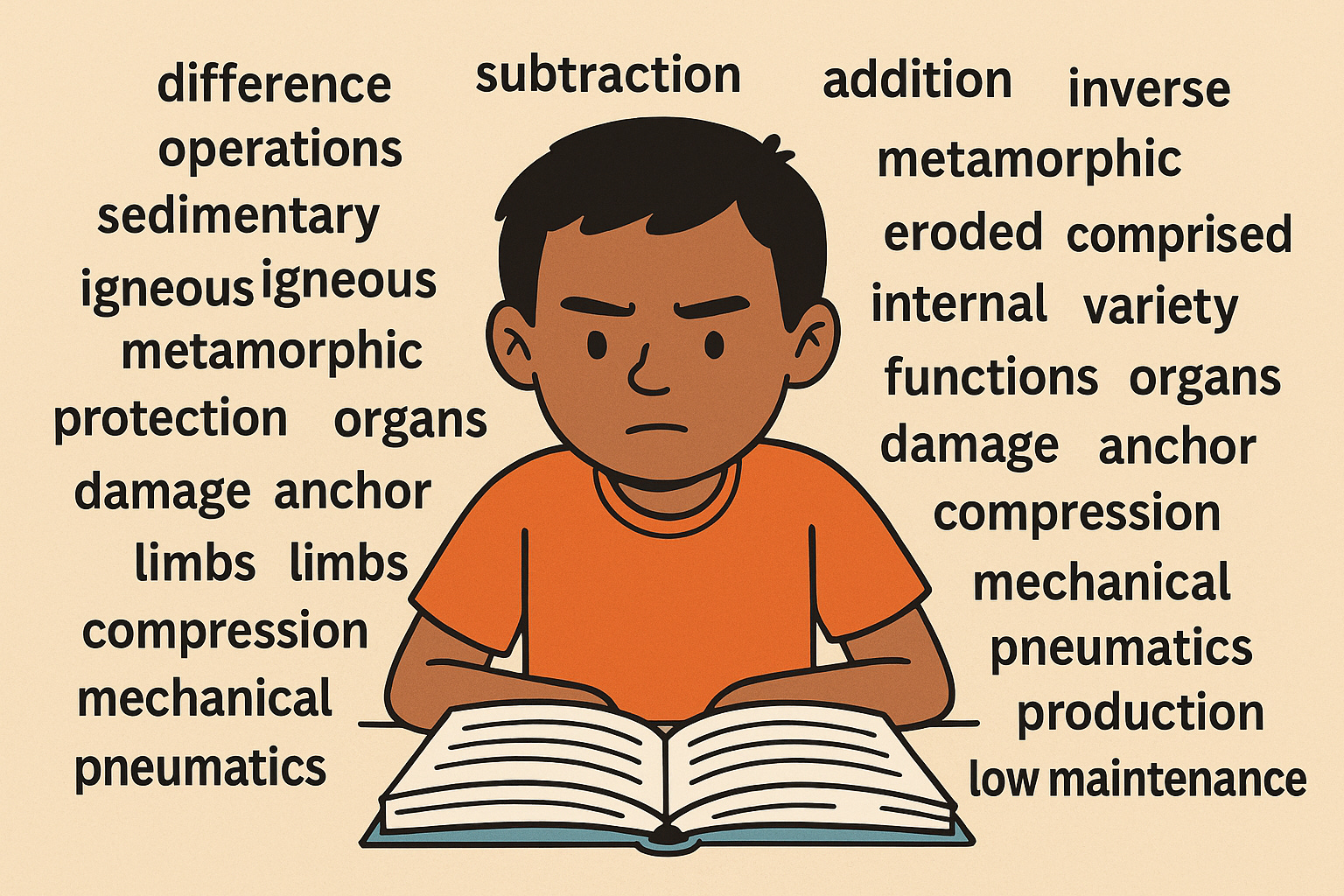
‘Find the difference between 812 and 357. Remember that “difference” means the result of subtracting the two numbers. You need to exchange a ten for 10 ones and a 100 for 10 tens. You can check the answer by adding 455 to 357. As 455+357 =812, it means that 812-357 = 455, so the answer is correct. You can always check addition by subtraction and subtraction by addition as these are inverse operations.’
Geography
‘There are lots of different kinds of rock, with different mixtures of minerals. But they fall into just three groups of rock – sedimentary, igneous and metamorphic. Each group has formed in a different way. Sedimentary rock forms when particles of minerals which were eroded from rock in one place get stuck together again in another place, to form a new rock.’
Science
‘Humans have a skeleton comprised of 206 bones. The human skeleton is an internal skeleton. The skeleton has a variety of functions. Protection: the skull protects the brain and the skeleton protects organs from damage, for example the ribs protect the lungs. Movement: the skeleton provides an anchor point for muscles and allows the movement of limbs and other parts of the body.’
Design Technology
‘Another form of compression is used to store gas or air under pressure. This area of mechanical power is known as pneumatics, where movement is controlled by using a system of valves, actuators, pistons and other dedicated controllers. Pneumatic systems are commonplace for controlling production lines in the manufacturing industry. They are accurate, efficient and relatively low maintenance.’
If we take just the vocabulary alone, the text above assumes understanding of: difference, subtraction, addition, inverse, operations, minerals, sedimentary, igneous, metamorphic, eroded, comprised, internal, variety, functions, protection, organs, damage, anchor, limbs, compression, mechanical, pneumatics, valves, actuators, pistons, dedicated, controllers, systems, production, manufacturing, industry, accurate, efficient, relatively and low maintenance. Comprehension depends not only on understanding the words, but also on making sense of the ideas they represent.
Natalie Wexler describes ‘an extricable two-way relationship between literacy and content knowledge’, explaining that ‘students need to learn how to read in order to acquire knowledge from texts’ and how ‘what individuals can read and understand, once they’ve learned foundational reading skills, depends largely on their knowledge of history, geography, science, literature, the arts, popular culture – pretty much any knowledge they’ve been able to acquire.’
Inevitably, then, reading barriers become learning barriers.
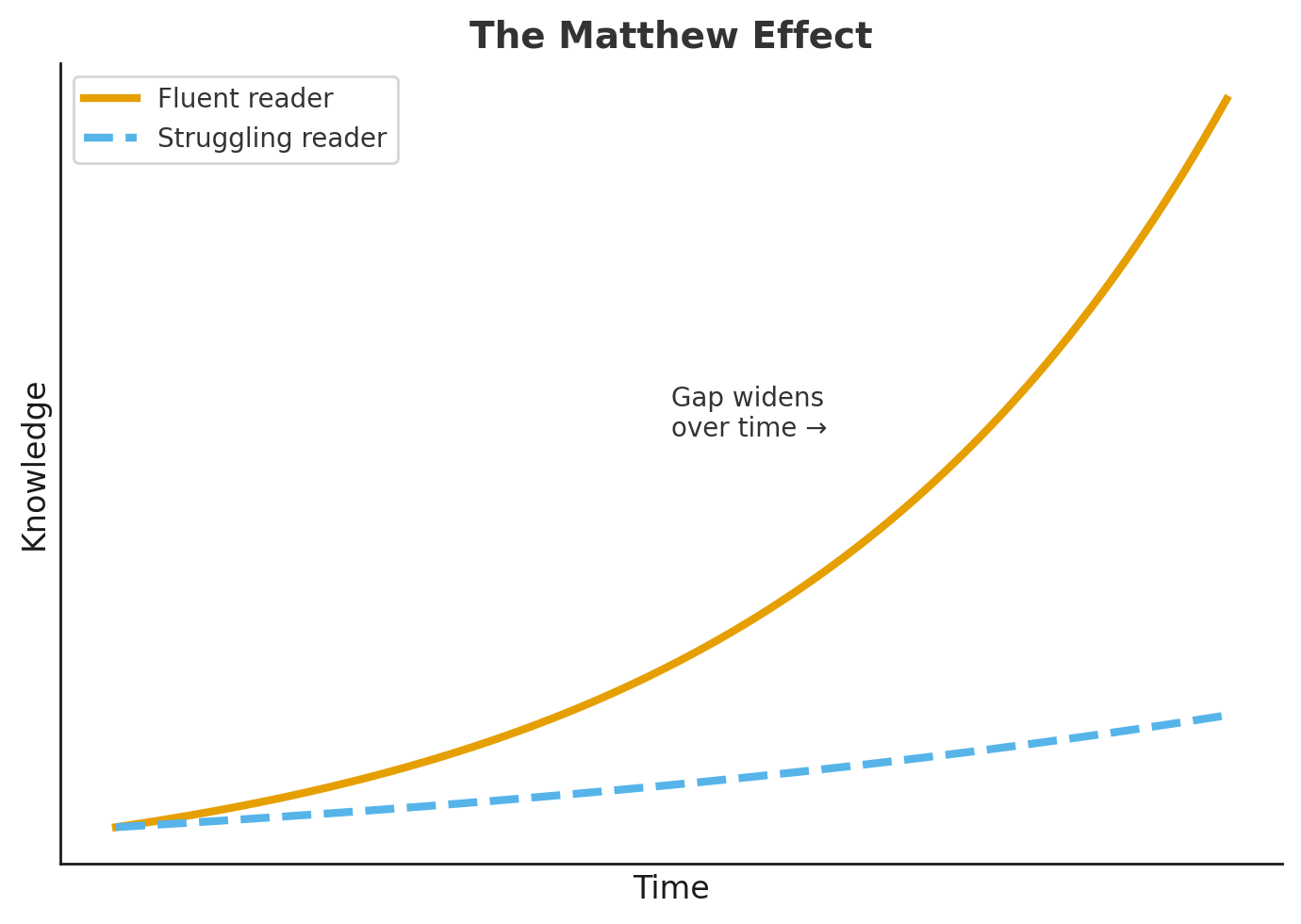
Students who face challenges in reading from an early age are unable to acquire knowledge from texts. Each lesson that relies on reading becomes another missed opportunity to build knowledge. Over time, these opportunities multiply.
A child who cannot access text throughout Key Stage 2 misses out on around 4,000 hours of classroom learning. While their peers’ learning accelerates, theirs stagnates.
This is the Matthew Effect in action: those who read more learn more; those who read less fall further behind.
By the time these students enter secondary school, what appears to be a learning gap is, in truth, a reading gap: the inevitable result of years without full access to text.
This is why teaching our children is our most important job and is everyone’s job. Alex Quigley rightly states here that ‘every teacher should be intent on ensuring every student becomes a knowledgeable and strategic reader’. The mountain is too steep for a few individuals to climb alone. We must also be wary of supposed ‘quick fixes’ or easy solutions to such a complex problem. As Quigley states, ‘when an easy solution is proposed for a complex problem, like coloured paper for struggling readers, we should assume it’s too good to be true.’ It requires a colossal collective and sustained effort in order to close the gaps that have persisted and compounded over years of a child’s education.
But it is worth the effort. Because, when we teach a child to read, we give them access to everything else.
To help reading leads share why reading matters so deeply, I’m sharing a free CPD resource:
The Reading Gap Behind Learning Difficulties: CPD and Discussion Task
From Alan Moore’s Jerusalem:
“As with much of the talk between her elders, Alma only caught the slender gist of it and wasn't really sure most of the time if she'd caught even that. Odd phrases and occasional expressions would lodge somewhere in her mind, provide a coat-rack of precarious hooks from which she could drape tentative connecting strings, threads of conjecture and wild guesswork linking up one notion with another until Alma either had a sketchy comprehension of whatever she had eavesdropped, or had burdened herself with a convoluted and ridiculous misunderstanding that she would continue to believe for years thereafter.”